 comparison
Bespoke Bedroom Wardrobe Carcass Supplier Guide
Table of Contents
- What to Look for in a Wardrobe Carcass Supplier
- Made to Measure Wardrobe Carcasses: Custom Dimensions and Design
- Wardrobe Carcass Materials and Construction Options
- Supply-Only Fitted Wardrobes: When You Don't Need Doors
- Wardrobe Carcasses Without Doors: Flexibility and Cost Savings
- Lead Times, Delivery, and After-Sales Support
- Choosing the Right Supplier for Your Project
- Frequently Asked Questions
Last Updated: October 5, 2026
What to Look for in a Wardrobe Carcass Supplier
Choosing a wardrobe carcass supplier affects your bedroom's functionality and aesthetics for years. The right partner demands clarity on materials, customisation, lead times, and support.
A quality wardrobe carcass supplier should be transparent about three things: construction methods (full carcass or supply-only), materials and finishes, and realistic timelines with clear communication if your needs change mid-project.
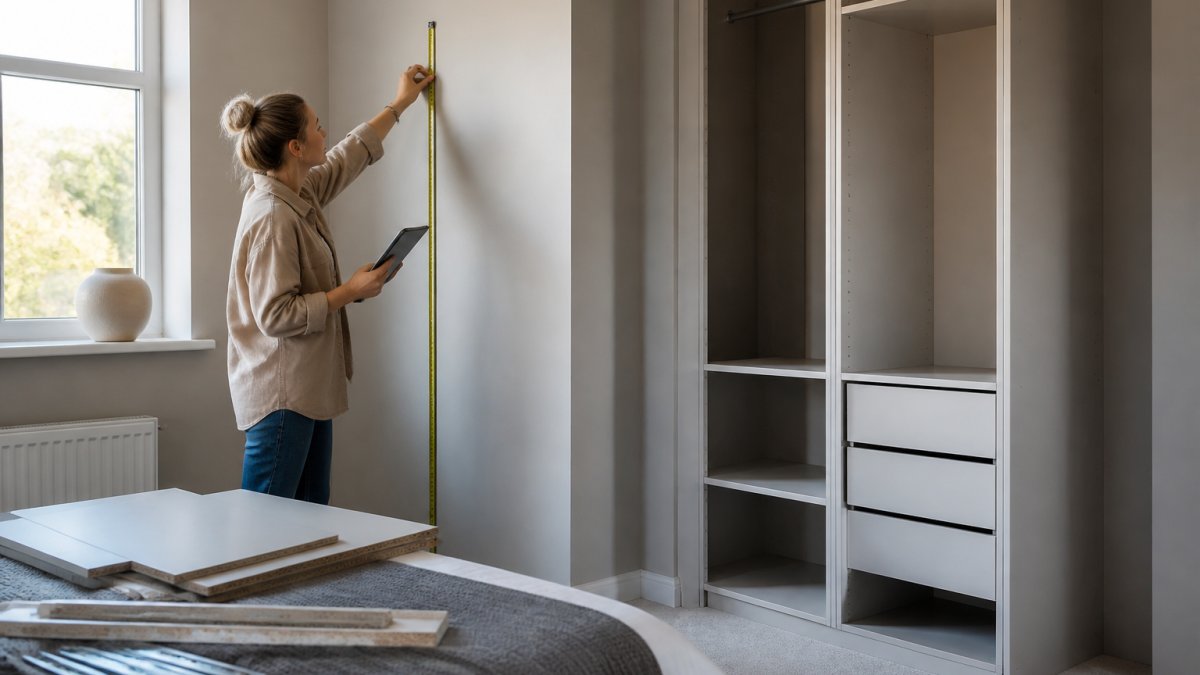
Look for suppliers offering a full design service using professional CAD software, which catches dimensional errors before production.
Made to Measure Wardrobe Carcasses: Custom Dimensions and Design
Made-to-measure wardrobe carcasses fit your exact space, adapting to walls, alcoves, and architectural quirks rather than forcing standard dimensions on your room.
You specify width, depth, and height to the millimetre, which matters because bedrooms rarely have square walls or uniform ceiling heights. A supplier who accounts for sloping ceilings, outlets, or radiators will design a wardrobe that looks built-in rather than inserted.
The process begins with detailed measurements and a site visit or photographic survey.
Custom dimensions also maximise awkward spaces: corner wardrobes wrap around a room without dead space, single wardrobes suit smaller bedrooms, and double wardrobes provide comprehensive storage for couples.
Wardrobe Carcass Materials and Construction Options
The carcass is your wardrobe's structural skeleton, so everything depends on its durability and stability. Understanding material options helps you choose a wardrobe carcass that lasts decades.
Board materials and where each one belongs
Most suppliers build carcasses from engineered board. The three most common:
- Melamine-faced chipboard (MFC), the workhorse of fitted bedroom furniture. The melamine face resists moisture and scuffs, and it is the most cost-effective option for bedroom humidity levels. It is not suitable for bathrooms or damp alcoves.
- Medium-density fibreboard (MDF), denser, more uniform, and better at holding a machined edge. It accepts paint and veneer finishes well, but swells if water sits on an unsealed edge, so it suits dry bedrooms and painted finishes rather than utility spaces.
- Moisture-resistant (MR) MDF or chipboard, a green- or blue-cored board for alcoves with known damp, en-suite-adjacent walls, or ground-floor bedrooms. It costs more but is the correct choice where a standard board would fail.
Board thickness and what it actually buys you
The industry default for carcass panels is 18mm. Some budget suppliers use 15mm or 16mm side panels, disguised with a thicker top and bottom. Quality suppliers typically use:
- 18mm for sides, tops, bottoms, and shelves on standard wardrobes.
- 25mm for shelves spanning more than roughly 900mm unsupported, or for full-height side panels on wide units.
- 8mm or 18mm back panels, an 8mm hardboard back is common on budget carcasses and offers little racking resistance; an 18mm back panel or a grooved 8mm panel set into a rebate is far more rigid and expected on a bespoke unit.
Ask for panel thickness in writing. "18mm throughout" is a meaningful commitment; "18mm where it matters" is not.
Edging and how it is applied
Every exposed board edge should be edged, not just the front. Two methods dominate:
- PVC or ABS edge tape, typically 0.4mm to 2mm thick. Thin 0.4mm tape chips easily; 1mm to 2mm ABS is more durable and better on shelf fronts and side panels.
- Solid timber or matching laminate lippings on premium painted or veneered carcasses, giving a cleaner painted edge that can be sanded back if damaged.
Check that the supplier edges all four sides of shelves and both long edges of side panels.
Dimensional tolerances
Bespoke does not mean infinite precision. A realistic tolerance is ±2mm on overall width, height, and depth, and ±1mm on shelf and divider positions; tighter adds cost and lead time.
Back-panel construction
The back panel stops a tall wardrobe from racking (twisting out of square) as doors open and close. Three approaches, in ascending rigidity:
- Stapled 3-6mm hardboard, cheapest, adequate only on short, narrow units.
- Grooved 8mm panel set into rebates in the sides, top, and bottom, the standard for mid-range bespoke carcasses and a good balance of cost and rigidity.
- 18mm full back panel, used on wide or full-height units, on wardrobes that will be free-standing rather than fitted between walls, and where the carcass may be moved.
Load capacity and shelf spans
Hardware compatibility
Carcass hardware is where cheap units fail first. Look for:
- Hinge mounting plates drilled to the 32mm system, so standard concealed hinges from Blum, Hettich, Grass, or Hafele fit without re-drilling.
- Drawer runners, Blum Tandem or Hettich AvanTech You are the common premium choices; cheaper roller runners are noisier and shorter-lived.
- Adjustable feet or a plinth system so the carcass can be levelled on an uneven floor without packing offcuts under it.
- Pilot holes and cam-and-dowel fittings rather than screws driven straight into the board edge, which splits MFC over time.
If you plan to add doors later, confirm now that the carcass is drilled for your intended hinge system, retrofitting hinge cups into a finished carcass is rarely neat.
Supply-Only Fitted Wardrobes: When You Don't Need Doors
Not every project requires doors. Supply-only fitted wardrobes offer professional-grade carcasses without the cost and complexity of integrated door systems.
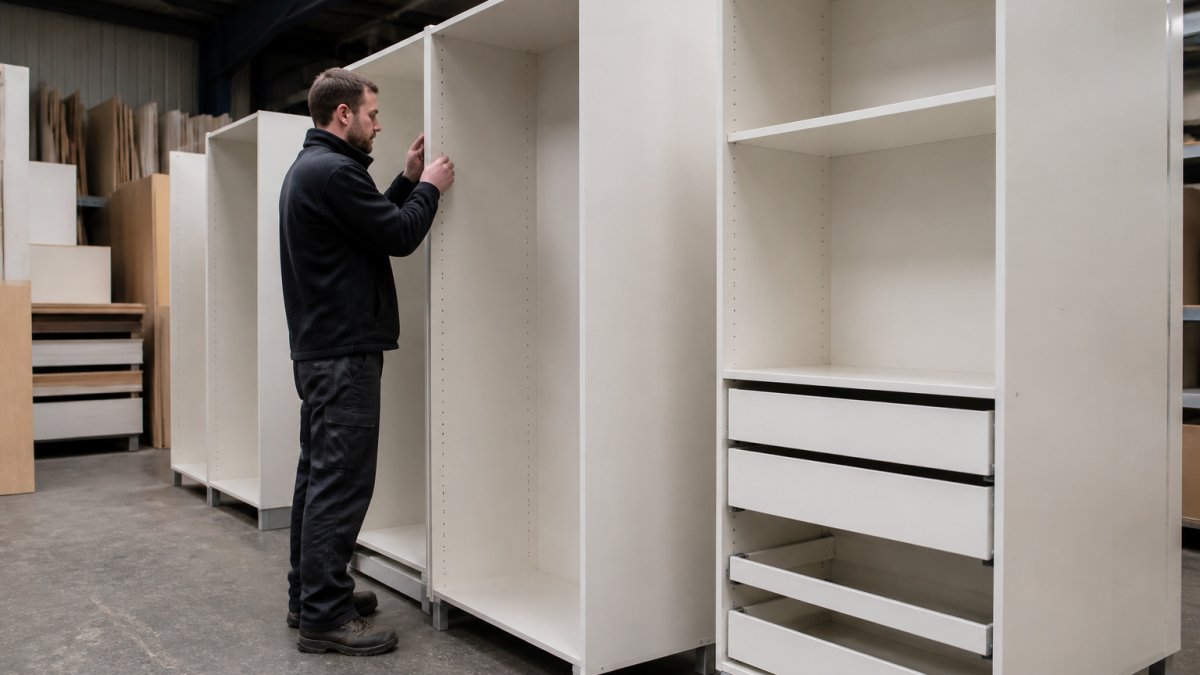
A supply-only wardrobe carcass gives you the full unit with shelving, rails, and internal configuration, ready for installation. You then source doors separately or leave it open, ideal for walk-in spaces or bedrooms where open shelving fits the aesthetic.
This appeals to several customer types. Interior designers prefer supply-only carcasses because they can specify doors from different manufacturers to match other bedroom elements.
When choosing a supply-only wardrobe carcass supplier, verify compatibility with standard door frames and hardware. A quality supplier provides detailed specifications so you can source complementary doors without dimensional surprises.
Wardrobe Carcasses Without Doors: Flexibility and Cost Savings
Wardrobe carcasses without doors are a growing trend, offering flexibility traditional fitted wardrobes cannot match.
Cost savings are immediate: doors represent a substantial portion of a fitted wardrobe's price, so removing them reduces your initial investment and frees budget for premium carcass materials.
Design flexibility is equally valuable. Open carcasses suit modern, minimalist bedrooms where clean lines and visible storage appeal, styled with books, baskets, or decorative items.
Practical considerations matter: without doors, dust accumulates more readily, so open storage works best with good air circulation and regular cleaning.
A wardrobe carcass supplier offering carcasses without doors should still provide quality interior fittings and finishes, the absence of doors doesn't excuse inferior materials or assembly.
Lead Times, Delivery, and After-Sales Support
Lead times separate reliable wardrobe carcass suppliers from those who overpromise. Understanding production time, delivery, and issue resolution protects your renovation timeline.
Typical lead times
For made-to-measure carcasses, a realistic range is:
- Standard sizes held in stock, dispatched within 2-5 working days.
- Made-to-measure single or double carcasses in a standard finish, typically 2-3 weeks from confirmed drawing to dispatch.
- Complex corner units, non-standard finishes, or spray-finished panels, typically 3-5 weeks, longer for specialist veneer or lacquer.
Lead time usually starts from approved CAD drawing and cleared deposit payment, not the initial enquiry. A supplier quoting from enquiry date is either holding stock or being optimistic, ask which event starts the clock.
What drives the price
Carcass pricing is not a single rate per metre. Main cost drivers, in rough order of impact:
- Dimensions, width, height, and depth scale board area, but height also drives shelf count and the back-panel method.
- Board and finish, MFC is the baseline; MR board, veneer, and spray-finished MDF each add a step.
- Internal configuration, drawers, pull-out trays, and shoe racks cost more than shelves and rails because of hardware and machining.
- Hardware brand, Blum and Hettich carry a premium over unbranded equivalents, but are the parts most likely covered by a manufacturer's long-term warranty.
- Delivery and access, upper-floor flats, narrow stairwells, and restricted parking can add to delivery cost or require a two-person team.
Ask for a written quote broken down by carcass, hardware, finish, and delivery.
Delivery coverage and access
Ask three questions before ordering:
- Is delivery included, or quoted separately? Many suppliers deliver free within a radius and charge beyond it.
- Is it kerbside or room-of-choice? Kerbside means you move flat-packed panels yourself; room-of-choice means the supplier's team carries them in.
- Are panels flat-packed or pre-assembled? Flat-packed carcasses are easier up tight staircases; pre-assembled units install faster but need more access room.
For flats and terraced houses, confirm the largest panel dimension against your stairwell and doorways, a 2.4m side panel will not turn a tight 90-degree bend.
Damage, returns, and replacements
A clear process here is a good sign. Expect the supplier to:
- Ask you to inspect on delivery and note any damage on the paperwork before signing.
- Replace damaged panels free of charge if reported within a stated window, commonly 48 hours to 7 days.
- Supply individual replacement panels rather than a whole new carcass, which matters if a shelf is damaged months later.
- State clearly whether bespoke items are returnable. Made-to-measure carcasses are usually non-returnable unless faulty, because they cannot be resold. This is normal, but should be stated up front.
Warranty and after-sales
Warranty terms vary widely. A common structure:
- Structural carcass, 5 to 10 years against manufacturing defects.
- Hardware, covered by the hardware manufacturer's own warranty, often considerably longer than the carcass warranty for Blum and Hettich.
- Finish, usually 1 to 2 years against peeling, blistering, or delamination under normal use.
Warranties typically exclude damp damage, incorrect installation, or normal wear.
Check current consumer rights on faulty goods and services
Choosing the Right Supplier for Your Project
Start by clarifying requirements: replacing an existing wardrobe or building from scratch? Full carcass with doors, or supply-only components? What timeline and budget? These answers narrow your options significantly.
Next, evaluate communication and transparency. Contact several suppliers with your specifications: do they ask clarifying questions about your space, or immediately quote a price?
Request references or case studies of similar bedroom projects, proven experience in your size and configuration reduces risk.
Finally, verify your chosen wardrobe carcass supplier can deliver on timescales matching your project.
At Wjskitchenwarehouse, we've supported trade professionals and homeowners through bedroom renovation projects for over 30 years.
Choosing the right wardrobe carcass supplier determines whether your bedroom renovation becomes a source of satisfaction or regret, influencing everything from fit to how smoothly installation unfolds.
Frequently Asked Questions
What is a wardrobe carcass and why does it matter when choosing a supplier?
A wardrobe carcass is the structural frame and side panels of a fitted wardrobe, excluding doors and interior fittings. It forms the foundation of your storage solution. When choosing a wardrobe carcass supplier, you need one that offers quality materials, precise dimensions, and reliable delivery. A good supplier will ensure your carcass is built to last, fits your space perfectly, and arrives on schedule, critical factors that affect the entire success of your bedroom renovation.
Can wardrobe carcasses be made to measure, and what does that involve?
Yes, made to measure wardrobe carcasses are the standard offering from quality suppliers. The process typically involves measuring your bedroom space precisely, discussing your storage needs and style preferences, and then manufacturing a carcass built to your exact dimensions.
What materials should I expect in a quality wardrobe carcass?
Quality wardrobe carcasses are typically constructed from engineered board materials such as MDF or plywood, chosen for durability and stability. The choice of carcass material affects longevity and cost.
Can I buy wardrobe carcasses without doors, and what are the advantages?
Yes, supply-only fitted wardrobes, carcasses without doors, are available and offer several advantages. You can add doors later, choose different door styles independently, or even leave sections open for a modern aesthetic. This approach also reduces upfront costs and gives you flexibility if your design plans change. It's ideal if you're phasing your renovation or want to source doors separately to match other bedroom furniture.