 ultimate-guide
Buy Custom Kitchen Doors Online: A 2026 UK Guide
Table of Contents
- Why Buy Custom Kitchen Doors Online in 2026?
- How to Measure Kitchen Cupboard Doors
- Vinyl vs Timber Kitchen Doors: Which Material Lasts?
- Replacement Kitchen Door Lead Times and Delivery
- DIY vs Professional Installation: A Cost-Benefit Analysis
- How to Order Samples and Visualise Your New Kitchen
- Conclusion
- Frequently Asked Questions
Last Updated: September 17, 2026
Why Buy Custom Kitchen Doors Online in 2026?
Buying custom kitchen doors online is now the default route for a serious kitchen renovation. This guide from Wjskitchenwarehouse explains how to get measurements, materials and lead times right the first time.
Replacing doors and drawer fronts leaves the carcasses, plumbing and wiring untouched, so disruption stays low while the visual change is dramatic. You get a new kitchen's appearance without paying for a new kitchen's structure.
At Wjskitchenwarehouse, we have supplied made to measure components for over 30 years, to homeowners and trade fitters alike. Below, we show you how to measure, choose materials and order samples so nothing arrives wrong.
How to Measure Kitchen Cupboard Doors
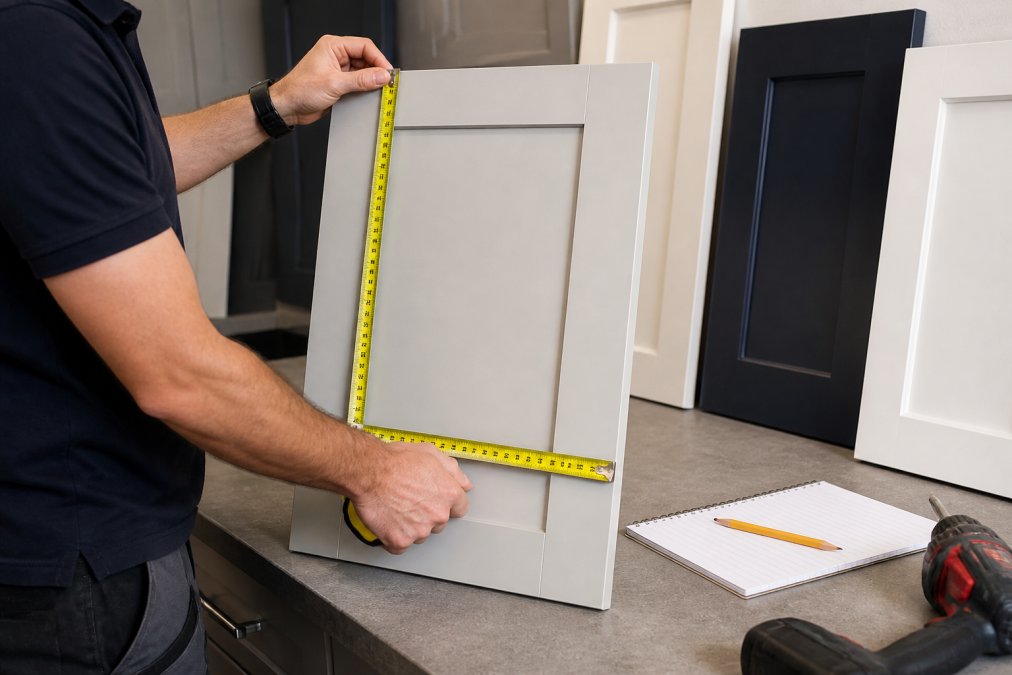
Measuring kitchen cupboard doors correctly means measuring the carcass opening, not the old door. The old door may have swollen, warped or been trimmed by a previous fitter, so copying it repeats someone else's mistake. This step decides whether your order arrives right.
What You Will Need
- A steel tape measure (a fabric one stretches and will cost you millimetres)
- A pencil and paper, or a phone note you can photograph
- A spirit level, to check the carcass is true
- A small square, for checking corners
Work in millimetres throughout, kitchen cabinetry is designed in metric, and mixing units causes ordering errors.
Measuring the Carcass vs. the Existing Door
Work from the cabinet opening itself. Measure the aperture's width and height in millimetres at the top, middle and bottom, and use the smallest figure. Cabinets are rarely perfectly square, and a door cut to the largest measurement will catch on the frame.
For a single door covering one opening, add 2mm to 3mm of overlay on each edge over the carcass. For a pair, add the overlay, divide by two and allow a 3mm central gap so the doors do not clash.
A worked example: a 500mm wide opening with 18mm carcass sides, using a 3mm overlay on each side, gives a total door width of 500 + 3 + 3 = 506mm. For a pair, each door is (506 − 3) ÷ 2 = 251.5mm, rounded to the nearest millimetre your supplier accepts.
Checking the Carcass Before You Order
Before committing to measurements, run three checks:
- Squareness. Measure both diagonals of the opening. If they differ by more than 2mm, the carcass has moved and new doors will sit proud or gap unevenly.
- Level. Place a spirit level across the top and bottom rails. A run that slopes will show as an uneven shadow line once doors are hung.
- Depth. Confirm the carcass depth is consistent. If a previous fitter packed one side forward, hinge overlay will differ across the run.
Accounting for Hinges and Handle Positions
Hinge holes are drilled to a standard 35mm diameter in most European-style cabinets, but the centre point and door overlay vary by hinge brand. If reusing existing hinges, measure from the door edge to the centre of each hinge hole and note it on your order. The key figures are the hinge cup centre distance from the door edge (commonly 21mm to 22.5mm) and the vertical spacing between hinges.
If buying new hinges, check the hinge's overlay range before ordering doors. A 110° clip-on hinge and a 165° hinge have different overlay capabilities, and the door drilling must match the hinge you intend to fit.
Handle positions matter too. Mark where you want the handle and check it clears the adjacent door, the drawer front below and any wall return.
Drawer Fronts and End Panels
Drawer fronts are measured differently. Measure the drawer box width and the front's height, then apply the same overlay logic as a single door. For pan drawers, check the front clears the handle of the drawer below when both are closed.
Vinyl vs Timber Kitchen Doors: Which Material Lasts?
Vinyl wrapped doors win on practicality for most kitchens; timber doors win on repairability and character. The right answer depends on how much moisture and knocks the doors will face.
| Material | Best For | Moisture Resistance | Maintenance |
|---|---|---|---|
| Vinyl wrapped | Busy family kitchens, modern finishes | High | Wipe with a damp cloth |
| Timber | Period properties, repainting | Moderate | Occasional sanding and oiling |
| Laminate | High | ||
| Moderate |
Replacement Kitchen Door Lead Times and Delivery
Replacement kitchen door lead times depend on whether you order from stock or made to order. Standard sizes held in stock move fastest; bespoke dimensions take longer because each door is cut and finished to your measurements.
A few things slow an order down:
- Measurements that need clarifying after the order is placed
- Hinge drilling positions that fall outside the standard pattern
- Colour or finish choices that need a bespoke match
- Delivery to an address with restricted access for larger items
DIY vs Professional Installation: A Cost-Benefit Analysis
Fitting replacement doors yourself is realistic for a competent DIYer, but it is not the same job as hanging a new kitchen. The carcasses are already fixed and level, removing most of the difficulty. The decision comes down to time, tolerance for rework and how complex your run is.
What the Job Actually Involves
The main tasks are removing the old doors, fitting new hinges, aligning doors so gaps are even, and adjusting the soft close mechanism. A cordless drill, screwdriver and spirit level cover most of it. Budget a weekend for a typical kitchen, more if also replacing drawer fronts and plinth.
When DIY Makes Sense
DIY suits standard carcasses, straight runs and a patient homeowner. If your cabinets are square, your hinges are standard 35mm Euro-style and you are replacing like-for-like sizes, the job is within reach of anyone comfortable with a drill.
When to Bring in a Joiner
Professional fitters earn their fee on awkward rooms: out-of-square walls, integrated appliances and runs where every door needs individual adjustment. If your cabinets are older or the room is tight, a fitter saves time and rework.
Signs you should book a joiner:
- The carcass diagonals differ by more than 2mm on more than one cabinet
- You are fitting doors around integrated appliances with fixed clearances
- The run includes a corner or a return where two doors meet at an angle
- You have a hard deadline, such as a rental turnover or a family event
The Hybrid Approach
A hybrid works well: measure and order yourself, then pay a fitter for a day to hang and align. You keep control of the specification and finish, and hand over the part where experience pays, final alignment and hinge tuning. Many fitters quote for a day's labour on this basis, often the most cost-effective route for a standard kitchen.
Maintaining Your New Doors by Finish
Once fitted, the finish you chose dictates how you care for it, where doors either stay looking new or age badly.
How to Order Samples and Visualise Your New Kitchen
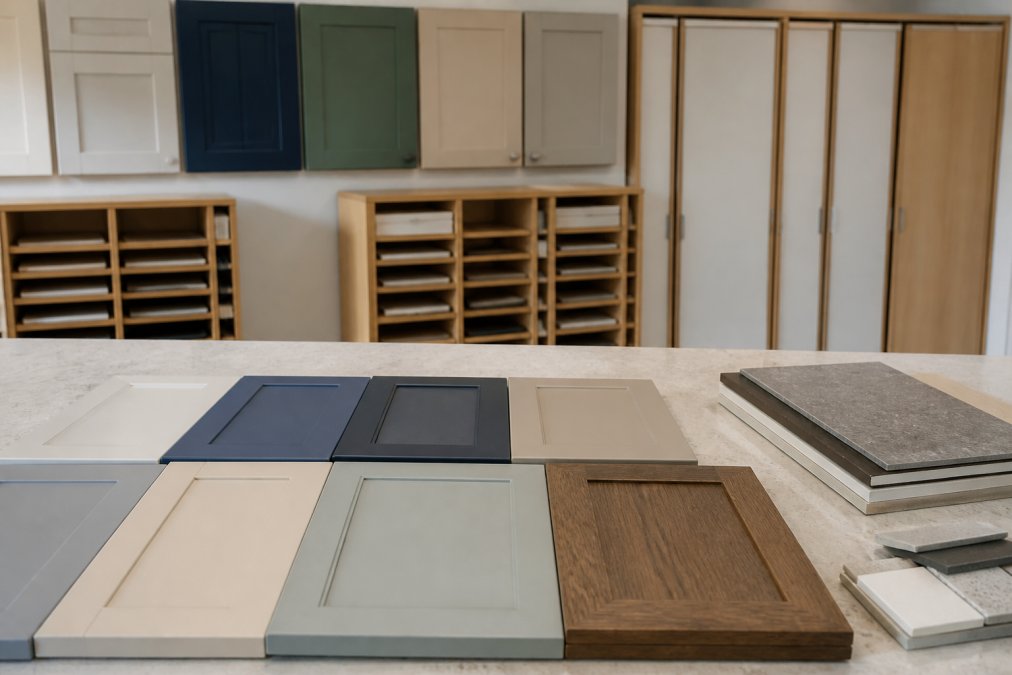
Ordering a sample door is the single most useful step before you buy custom kitchen doors, because it lets you check the finish, weight and edge banding in your own light. Most suppliers, including Wjskitchenwarehouse, send samples so you can compare options side by side.
Conclusion
Getting a kitchen transformation right comes down to accurate measurements, the right material and a realistic lead time, three things easy to get wrong under pressure. Wjskitchenwarehouse supplies made to measure doors and carcasses to trade and retail customers, backed by over 30 years of experience and a design service that takes you from sketch to order. With stock doors for standard sizes, made to order options for bespoke dimensions, and lead times from 14 to 28 days depending on product type, you can plan with confidence.
Frequently Asked Questions
How do I measure for replacement kitchen doors?
Measure the carcass opening itself. Record the width and height in millimetres at three points (top, middle, bottom) and use the smallest measurement. For height, measure the aperture's height. Always note which side the hinges sit on and the distance from the hinge hole centre to the door edge. If you are unsure, our design service can help ensure accurate measurements.
Are made-to-measure kitchen doors worth the investment?
They are worth it when standard sizes will not fit your existing carcasses or when you want a specific finish that is not available off the shelf. Custom doors let you keep the cabinet boxes, which saves the cost and disruption of a full rip-out. They also allow you to match odd dimensions, such as a run that ends at a boiler or an awkward corner. If your carcasses are sound, replacing only the doors is a practical and cost-effective update.
What is the typical lead time for custom kitchen doors?
Lead times depend on the product type. Vinyl and timber doors typically take between 14 and 28 days from order to delivery. Stock items for standard sizes may arrive sooner. If you have a fixed deadline, check the current lead time for your chosen finish before ordering. Ordering samples first adds a few days but helps you avoid delays caused by a wrong choice.
Can I replace just the doors on my existing kitchen cabinets?
Yes, provided the carcasses are solid and square. Replacement cupboard doors and drawer fronts are made to fit your existing boxes. Check that the hinges are in good condition and that the carcass panels are not swollen or damaged. If the boxes are chipboard and have been exposed to moisture, replacing the doors alone may not solve the problem. In that case, new carcasses are a better long-term option.