 ultimate-guide
Choosing Durable Kitchen Worktop Materials: A 2026 Guide
Table of Contents
- What Makes a Kitchen Worktop Durable
- Granite vs Quartz Worktops: Price Per Metre and Performance
- Best Heat Resistant Kitchen Worktop Materials
- Laminate vs Solid Surface Worktops: Pros and Cons
- Durability Ratings: Scratch, Stain and Impact Resistance
- Maintenance and Long-Term Care for Durable Worktops
- Making Your Choice: Installation, Repair and Lifestyle Fit
- Frequently Asked Questions
Last Updated: September 23, 2026
What Makes a Kitchen Worktop Durable
Durability in kitchen worktops comes down to how well a material resists the everyday stresses of cooking, cleaning, and regular use. When we talk about durable kitchen worktop materials, we're really asking which surfaces can handle heat, moisture, scratches, and stains without degrading over years of service. At Wjskitchenwarehouse, we've learned that durability isn't just about one property; it's a combination of heat resistance, scratch resistance, stain resistance, and structural integrity.
The most durable worktops share a few core characteristics. They have a non-porous or sealed surface that resists moisture penetration, which prevents swelling, warping, and bacterial growth. They maintain their appearance under thermal stress, meaning they won't crack or discolour when you place a hot pan directly on them. They resist impact damage from dropped knives or heavy cookware. And crucially, they're easy to maintain without requiring constant resealing or specialist treatments.
Different materials achieve durability in different ways. Engineered stone, for example, uses a polymer resin matrix to bind quartz particles together, creating a surface that's harder than natural stone. Solid surface materials are homogeneous throughout, so minor scratches can be sanded out. Laminate offers affordability but trades long-term durability for initial cost. Understanding these trade-offs helps you match your material choice to your kitchen's actual demands and your lifestyle.
Granite vs Quartz Worktops: Price Per Metre and Performance
Granite and quartz represent the premium end of the worktop market, and they're often compared directly because they occupy similar price brackets and aesthetic territory. Both are natural-looking, hard-wearing, and built to last decades with proper care.
Granite is quarried natural stone, which means each slab is genuinely unique in colour, veining, and pattern. It's exceptionally heat resistant, you can place a hot pan straight from the hob without risk. Granite is also highly scratch resistant due to its crystalline structure. However, granite is porous, which means it requires regular sealing (typically every 12-18 months) to prevent staining and moisture absorption. The sealing process adds to long-term maintenance costs. Granite also carries a significant price per linear metre, though costs vary widely depending on the specific stone and its rarity.
Quartz worktops are engineered stone, made from crushed quartz particles bound with polyester or epoxy resin. They offer the visual appeal of natural stone, available in hundreds of colours and patterns, without the maintenance burden. Quartz is non-porous, so it doesn't need sealing. It's extremely durable, resisting scratches, stains, and thermal shock better than granite in most real-world scenarios. The trade-off is that quartz can be damaged by prolonged direct heat from professional-grade hobs, and some lower-grade quartz can show visible wear more quickly than premium granite. Price per linear metre for quartz typically sits between granite and solid surface materials, though premium brands command higher prices.
For most homeowners, quartz offers better value because you're paying for durability without the ongoing sealing costs. Granite appeals to those who prioritise the authenticity of natural stone and are willing to commit to regular maintenance.
Best Heat Resistant Kitchen Worktop Materials
Heat resistance matters because kitchens are inherently hot environments. You need a worktop that won't crack, discolour, or warp when exposed to high temperatures.
Granite and quartz are both excellent at heat resistance. Granite can handle direct heat from a hot pan without any risk of damage, you can place a pan straight from the hob onto the surface. Quartz is also highly heat resistant, though manufacturers typically recommend using a trivet for extended periods of direct contact with very hot cookware, as extreme heat can potentially damage the resin binder. In practice, most home cooks won't exceed quartz's heat tolerance.
Solid surface materials like Corian offer moderate heat resistance. They can handle brief contact with hot items but shouldn't be exposed to prolonged direct heat. Laminate, conversely, has poor heat resistance and can blister, warp, or discolour if exposed to high temperatures. Laminate worktops require trivets and heat mats as standard practice.
Stainless steel, popular in professional kitchens, is extremely heat resistant and won't warp or discolour. However, it's prone to fingerprints and scratches, and it can feel cold and industrial in a residential setting.
For a kitchen where you regularly move hot pans directly from hob to worktop, granite or quartz are your safest bets. If you're willing to use trivets consistently, solid surface materials provide a more budget-friendly alternative without sacrificing too much performance.
Laminate vs Solid Surface Worktops: Pros and Cons
These two materials occupy the mid-market space, more affordable than natural stone or quartz, but offering different trade-offs in durability and longevity.
Laminate Worktops
Laminate consists of a thin decorative layer bonded to a particleboard or MDF base. It's available in hundreds of colours and patterns, including convincing stone and wood effects. Installation is straightforward, and the upfront cost is significantly lower than premium materials.
The main drawback is durability. Laminate is vulnerable to moisture damage, particularly around sink areas and where water can seep into cut edges. Prolonged exposure to moisture causes the base to swell and delaminate, the decorative layer separates from the base. Laminate also scorches easily and isn't heat resistant. Scratches and chips are visible and difficult to repair. The surface doesn't age gracefully; after 10-15 years, laminate worktops typically show visible wear.
Laminate works well for rental properties, temporary solutions, or kitchens where budget is the primary constraint. For homeowners planning to stay in their property long-term, laminate is a false economy.
Solid Surface Worktops
Solid surface materials like Corian are homogeneous acrylic or polyester compounds. They're non-porous, so they resist moisture and staining. Minor scratches can be sanded out, making them genuinely repairable in ways laminate isn't.
| Material | Heat Resistance | Scratch Resistance | Maintenance | Typical Lifespan | Best For |
|---|---|---|---|---|---|
| Granite | Excellent | Excellent | Requires sealing | 20+ years | Natural stone preference, high-use kitchens |
| Quartz | Excellent | Excellent | Minimal | 20+ years | Low-maintenance durability |
| Solid Surface | Moderate | Good | Easy cleaning | 15-20 years | Design flexibility, balanced budget |
| Laminate | Poor | Poor | Basic cleaning | 10-15 years | Budget-conscious, short-term use |
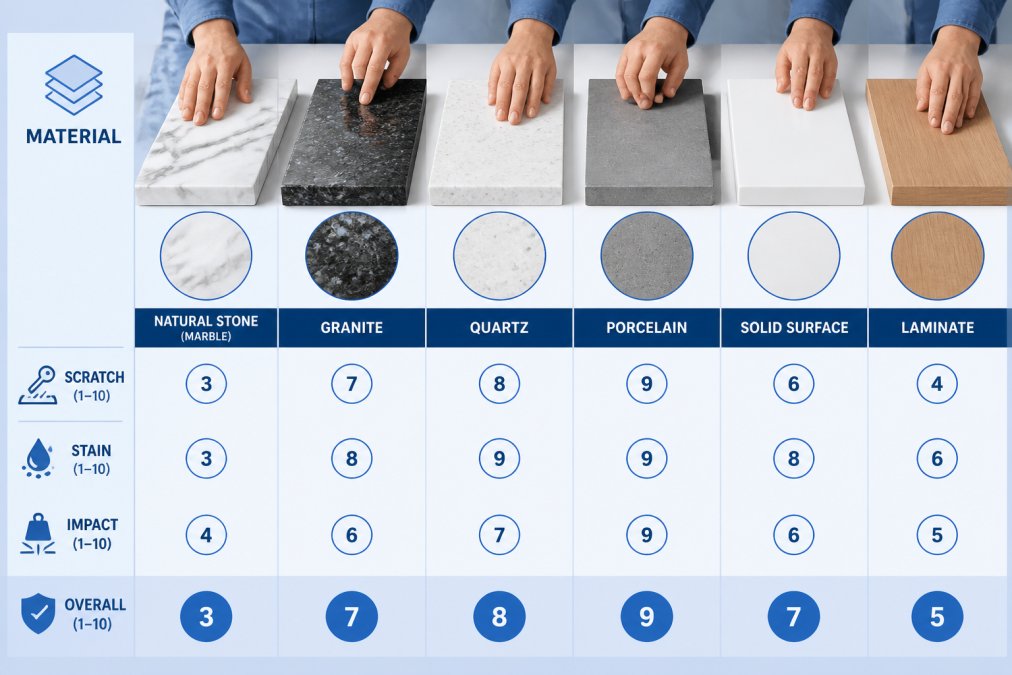
Durability Ratings: Scratch, Stain and Impact Resistance
Different materials perform very differently under stress, and understanding these differences helps you predict how your worktop will age.
Maintenance and Long-Term Care for Durable Worktops
How you care for your worktop directly affects how long it lasts and how well it looks. Different materials require different approaches.
Making Your Choice: Installation, Repair and Lifestyle Fit
Choosing a worktop material isn't just about material properties; it's about how the worktop will fit into your actual kitchen life.
Frequently Asked Questions
Which is the most durable kitchen worktop material?
Engineered stone (quartz) and natural granite are among the most durable kitchen worktop materials, offering excellent scratch and heat resistance. Quartz is non-porous, requiring minimal sealing, whilst granite delivers timeless durability with proper maintenance. Your choice depends on lifestyle: quartz suits high-traffic kitchens where minimal upkeep matters; granite appeals to those willing to seal periodically for natural beauty and long-term investment value.
How do quartz and granite worktops compare in price per metre?
Pricing for both materials varies based on quality grade, finish, edge profile and thickness. Contact Wjskitchenwarehouse for current quotes tailored to your specifications. Generally, costs depend on quantity, delivery dates and any bespoke features like upstands or splashbacks. Our design service can provide accurate pricing once your exact requirements are confirmed.
What are the best heat resistant kitchen worktop materials?
Granite, quartz, and solid surface materials offer superior heat resistance. Granite handles thermal shock well without damage. Quartz resists heat effectively but avoid prolonged direct contact with very hot pans. Laminate and composite materials have lower heat tolerance and require trivets or hot pads. For busy kitchens with frequent cooking, natural stone or engineered stone provides reliable, long-term heat protection without concern.
Should I choose laminate or solid surface worktops?
Laminate offers budget-friendly durability with decent stain and scratch resistance, though it requires careful maintenance to prevent delamination and moisture damage. Solid surface materials provide superior non-porous properties, seamless finishes, and easier repair through resurfacing. Solid surface suits kitchens where hygiene and aesthetic consistency matter; laminate works well for cost-conscious renovations. Both are food-safe when properly finished.
How often do durable worktops need sealing or maintenance?
Granite typically requires sealing every 1-3 years depending on use and finish. Quartz is non-porous and requires no sealing, only regular cleaning. Solid surface needs occasional resurfacing to restore the finish. Laminate needs no sealing but benefits from prompt cleaning to prevent moisture ingress. Maintenance schedules depend on your kitchen lifestyle: busy families with high wear may need more frequent care than lighter-use kitchens.
Can durable worktops be repaired if damaged?
Repairability varies by material. Granite and quartz can be professionally polished or honed to remove minor scratches; deeper damage may require patching. Solid surface excels here, minor scratches and stains can be resurfaced, restoring the original finish. Laminate is harder to repair; damage often requires section replacement. When choosing, consider whether you value easy restoration: solid surface and natural stone offer better long-term repair options than laminate.
What worktop material is best for a high-traffic kitchen?
Quartz and granite are ideal for high-traffic kitchens due to exceptional scratch and stain resistance, combined with minimal maintenance. Quartz's non-porous surface resists bacteria and food stains without sealing. Granite's durability rating remains excellent with periodic care. Solid surface also performs well in busy kitchens, offering hygiene properties and easy cleaning. Avoid laminate in very high-traffic areas where impact resistance and wear and tear are concerns.