 listicle
9 Best Kitchen Drawer Storage Solutions for 2026
Quick Summary
The best kitchen drawer storage depends on matching the organiser to your drawer rather than choosing the priciest insert. Options range from cutlery trays and adjustable dividers to bins for deep drawers, pan dividers and shallow organisers. Measure the internal width, depth and usable height before buying.
- Measure internal width at both the front and back, since drawers often taper.
- Measure between runner covers, not cabinet sides, to account for hardware.
- Measure your tallest item standing upright when planning pan storage.
- A cutlery tray that is too shallow can let knife blades rest on the drawer base.
- Expandable organisers need a consistent width to grip; tapered drawers suit modular dividers better.
Table of Contents
- How We Compared These Kitchen Drawer Storage Options
- Quick Comparison of the Best Kitchen Drawer Organisers
- Cutlery Trays and Utensil Inserts for Everyday Use
- Adjustable Kitchen Drawer Dividers and Expandable Organisers
- Deep Kitchen Drawer Storage: Making Use of Depth
- Pots and Pans Drawer Storage Options
- Measuring Your Drawer and Choosing the Right Organiser
- Booking a Drawer Planning Consultation With Wjskitchenwarehouse
- Frequently Asked Questions
How We Compared These Kitchen Drawer Storage Options
Last Updated: November 5, 2026
Kitchen drawers fill up fast, and most of the clutter ends up in the same place: a jumble of cutlery, lids and loose utensils. At Wjskitchenwarehouse, we supply kitchen components for trade and retail customers, and we know how much a well-planned drawer changes the daily routine. Good kitchen drawer storage is less about buying the most expensive insert and more about matching the organiser to the drawer you actually have.
This guide covers nine options for 2026, grouped by the job they do: cutlery, deep drawers, shallow drawers and pan storage. We judged each one on fit, build quality, how easily it adjusts and how well it suits everyday cooking. Where the source material did not give a price or dimension, we say so rather than guessing.
Pricing depends on the size you choose, the number of pieces in a set and when you buy, so check our website for current prices or a quote.
Quick Comparison of the Best Kitchen Drawer Organisers
- Best for cutlery: the Craftsman Cutlery Drawer Insert
- Best for mixed utensils: the 33-1/8-inch Utility and Cutlery Tray in wood
- Best for vertical space: the Two Tiered insert
- Best for adjustable fit: the Pipishell Bamboo Expandable Organizer
- Best for shallow drawers: the iDesign Linus Shallow Drawer Organizers
Use this list as a starting point. The sections below explain where each option works well and where it falls short.
Cutlery Trays and Utensil Inserts for Everyday Use
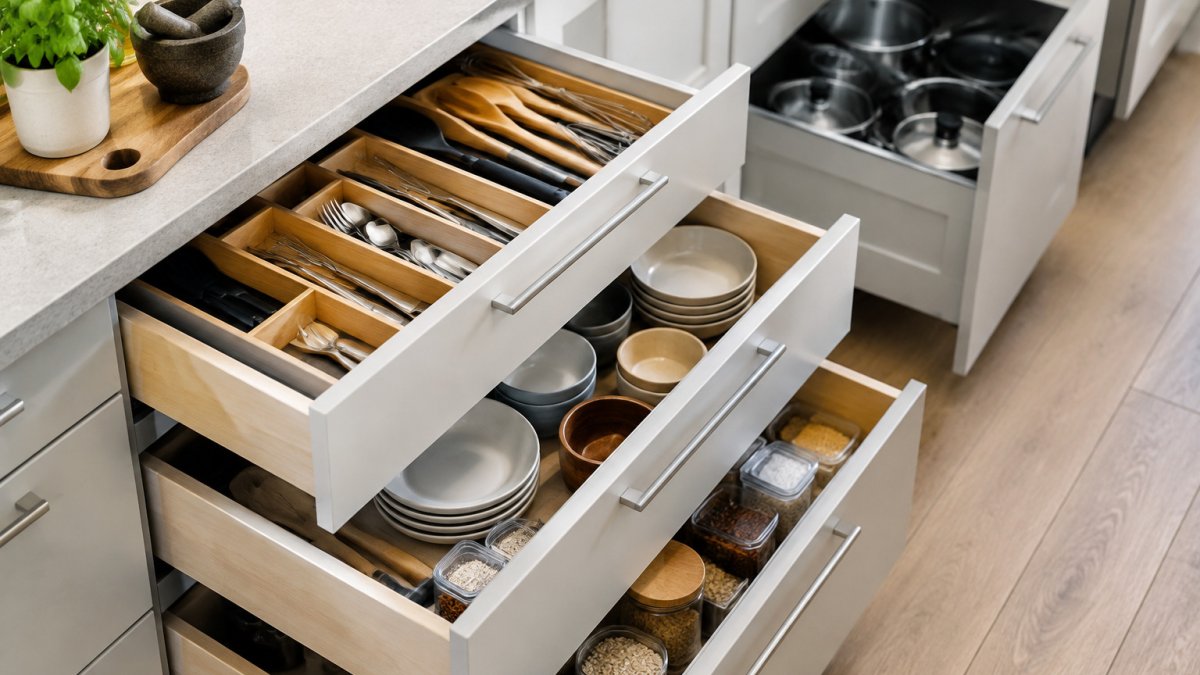
A cutlery tray is the simplest upgrade for a kitchen drawer, and it is often the first one people buy.
Watch out: a cutlery tray that is too shallow for your longest knives will let blades rest on the drawer base and dull their edges over time.
Adjustable Kitchen Drawer Dividers and Expandable Organisers
Adjustable dividers are the right choice when your drawer layout is still changing, when you have an awkward drawer width, or when you want to reconfigure zones without buying a new insert. Before you settle on a divider system, see how to judge the quality of the cabinet doors and fronts that these drawers sit behind. The mechanism matters more than the finish: a spring-loaded expandable organiser grips the drawer sides and stays put, while a segmented divider set relies on friction or adhesive pads and can shift if the drawer is deep or the items are heavy.
For a fitted kitchen, a drawer planning consultation can help you work out how many dividers you need and where the fixed zones should sit before you buy. If you are choosing between expandable and modular, measure the internal width at the front and back of the drawer first: expandable units need a consistent width to grip, while modular dividers work better in drawers that taper.
Watch out: an expandable divider that is set too tight can bow the drawer sides over time, and one set too loose will slide forward every time the drawer is opened.
Deep Kitchen Drawer Storage: Making Use of Depth
Deep drawers can become hard to use because items sink to the back and get lost. A shallow organiser does little here, so look for a bin or tray that sits at the right height for the drawer's depth.
Many home cooks find that a deep drawer works best when the front holds the items they use daily and the back holds the rest. A bin or two can keep those zones clear.
Pots and Pans Drawer Storage Options
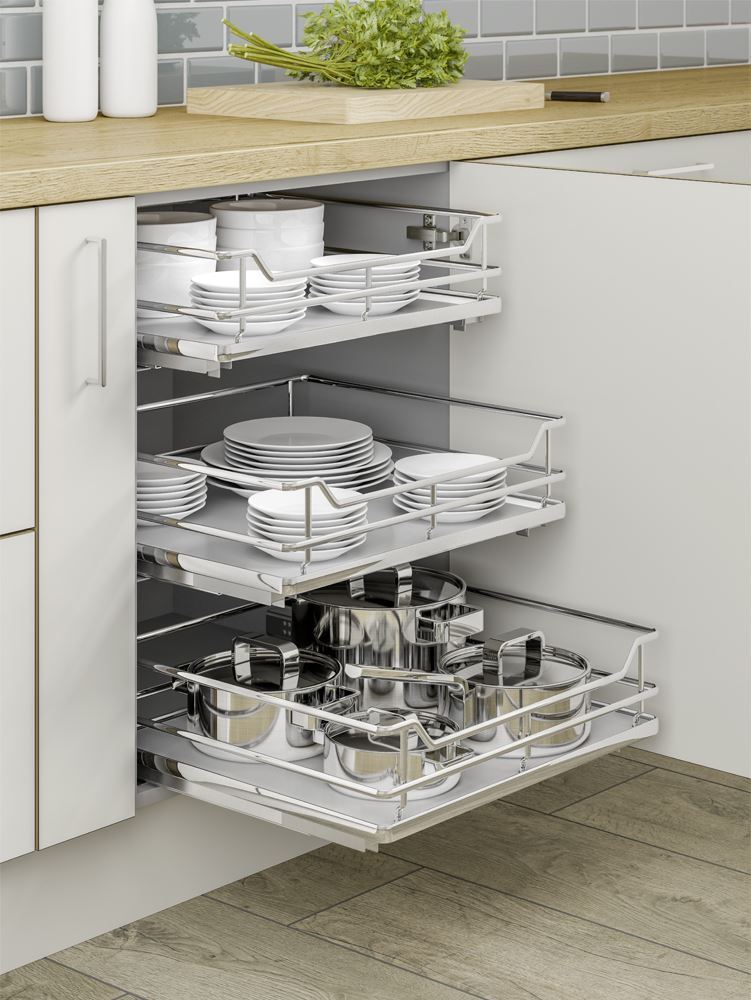
Pans are heavy and awkward to stack, and a deep base drawer is often the most practical place to keep them. A tidy setup stands pans on edge and uses a divider to stop them sliding together. Lids can sit in a separate section beside them.
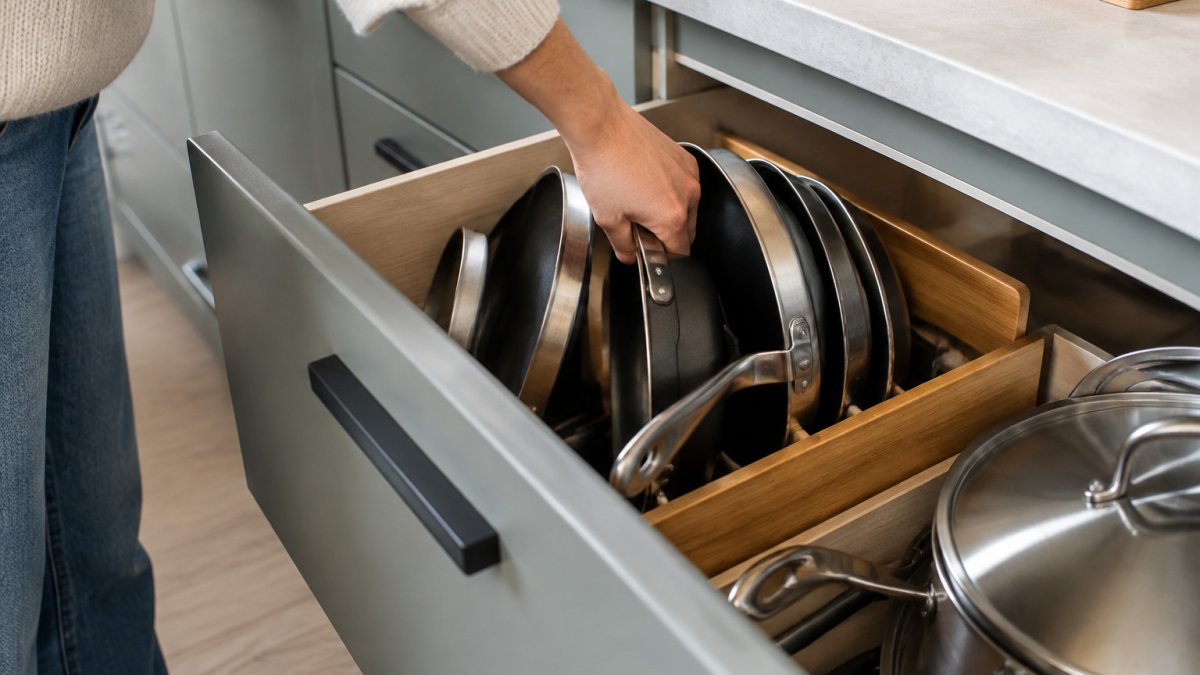
When picking a divider for pans, measure the drawer's internal width and the height of your largest pan before buying. A divider that is too tall will stop the drawer closing fully, and one that is too short will not hold the pans upright.
Measuring Your Drawer and Choosing the Right Organiser
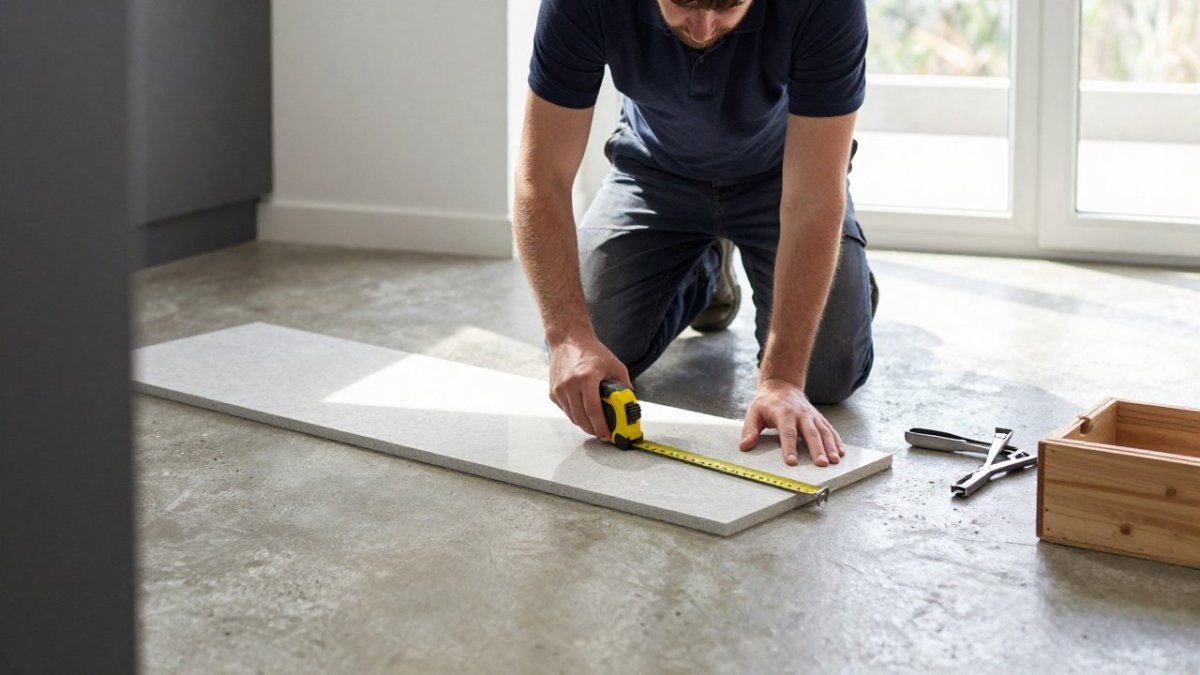
Fit matters more than style, and most returns happen because the drawer was measured at the top rather than at the base. Learn how to measure kitchen cabinets correctly before you order anything. Measure the internal width at the front and back of the drawer base, the internal depth from the drawer front to the back panel, and the usable height from the drawer base to the underside of the drawer side or the closed drawer front. Measure the front and back widths separately, because many drawers taper by a few millimetres and an expandable organiser needs a consistent width to grip.
Account for hardware before you choose. Drawer runners, soft-close mechanisms and side-mounted slides reduce the usable internal width, so measure between the runner covers rather than between the cabinet sides. If the drawer has a cutlery insert already fitted, measure the space inside it rather than the whole drawer, because a new tray has to sit within the existing recess or replace it entirely.
Then sketch the drawer and note the items you store most often. Put daily items at the front and heavier items low and toward the back, so the drawer does not become top-heavy. Choose an organiser that fits the zones you have sketched rather than one that fills the whole drawer.
Clearance is the step most people skip. An expandable organiser needs a small gap on each side so it can flex without bowing the drawer, and a two-tier insert needs enough height for both levels to clear the drawer's upper edge when it closes. For deep drawers, measure the height of your tallest item standing upright, not lying flat, because a pan stored on edge needs more headroom than one stacked.
If you are unsure how to measure a kitchen accurately, our measuring guides explain the process step by step. Read this accuracy-focused measuring guide to confirm each measurement before you buy. They are a good place to start before you order, particularly if your drawers are part of a fitted run where the carcass dimensions differ from the door front.
Watch out: measuring only the drawer opening rather than the internal base is the most common cause of an organiser that arrives too wide or too shallow to sit flush.
Measuring the drawer correctly comes first, and the article breaks the key checks into these steps:
| Measurement | Where to measure | Why it matters |
|---|---|---|
| Internal width | Front and back of the drawer base | Drawers often taper, and expandable units need a consistent width |
| Internal depth | Drawer front to back panel | Sets how far items can sit from the front |
| Usable height | Drawer base to underside of drawer side or closed front | Determines whether tall items and two-tier inserts fit |
| Hardware clearance | Between runner covers, not cabinet sides | Runners and soft-close parts reduce usable width |
| Tallest item | Measured standing upright | Pans on edge need more headroom than stacked ones |
Booking a Drawer Planning Consultation With Wjskitchenwarehouse
If you are planning a larger kitchen project, or want a drawer layout designed around your cabinets, a planning consultation can help. Find out how custom kitchen unit design is planned before you book. We offer a full design service using Articad CAD design software, so you can see how each organiser fits before anything is ordered.
Get started with Wjskitchenwarehouse for a design service and let our team check the fit before you buy.
Frequently Asked Questions
What is the best way to organise kitchen drawers?
Start by grouping items by how often you use them and what they are. Keep cutlery, utensils and small tools in their own compartments, and store the items you reach for daily at the front. Measure the drawer before buying anything, because an organiser that is too wide or too deep will slide around or leave gaps. Most people find that one tray for cutlery plus one or two adjustable dividers covers the majority of standard drawers, with the rest sorted by frequency of use.
How do you measure a kitchen drawer for an organiser?
Measure the internal width at the front, middle and back, since drawers are often slightly narrower at the rear. Note the internal depth and the height above the base to check clearance for taller inserts. Use the smallest of the width measurements as your limit. Allow a few millimetres of clearance so the organiser lifts out easily. Measurements are best taken to the nearest millimetre, and written down before shopping so you can compare them with product dimensions.
Are adjustable kitchen drawer dividers worth it?
Adjustable dividers are worth considering if your drawers vary in size or you change what you store over time. They let you resize compartments as needed, which suits mixed drawers holding cutlery, gadgets and spices. Fixed inserts are simpler and often sturdier, so they may suit a single purpose drawer better. Check that dividers hold their position under daily use before committing to a full set.
How can you organise a deep kitchen drawer?
Deep drawers work best with tiered or stacking inserts that use the vertical space, so smaller items are not lost at the back. Place frequently used items at the front where they are easy to reach, and store bulkier or occasional items towards the rear. Divide the drawer into zones for cooking tools, dry goods and kitchen equipment. Deep kitchen drawer storage is most effective when each zone has a clear purpose, so that you can see everything at a glance.