 blog
Custom Kitchen Carcasses vs Flat Pack: 5 Key Differences
Last Updated: October 25, 2026
Quick Summary
Custom kitchen carcasses vs flat pack represents two fundamentally different approaches: custom carcasses are bespoke cabinet boxes built to your exact specifications with 14-day lead times, while flat-pack units are pre-manufactured and arrive in pieces requiring assembly. Custom carcasses fit non-standard spaces and offer design flexibility, whereas flat-pack cabinets are more affordable upfront but limited to standard dimensions and require assembly labour.
- Custom carcasses typically last 20+ years with high durability, while flat-pack cabinets typically last 10-15 years with moderate durability.
- Flat-pack assembly takes 2-4 days for a full kitchen, while custom carcasses arrive pre-assembled and ready for doors and worktops.
- Custom carcasses use plywood or solid wood with full 18mm back panels; flat-pack typically uses particleboard or MDF with thin hardboard backs.
- Once you add assembly time, filler panels, hardware upgrades and rework allowance, the installed cost gap between custom and flat-pack is usually much smaller than the box price suggests.
- Choose custom carcasses for non-standard spaces, long-term durability and design flexibility; choose flat-pack for simple rectangular layouts and faster completion with lower upfront cost.
Table of Contents
- What Are Custom Kitchen Carcasses and Flat-Pack Cabinets?
- Cost Comparison: Custom Carcasses Against Flat-Pack Options
- Understanding Flat-Pack Kitchen Cabinets and Assembly Requirements
- Custom-Sized Kitchen Cabinets: Design Flexibility and Fit
- Flat-Pack Kitchen Assembly: Time, Effort, and Installation Timelines
- Kitchen Carcass Materials: Construction Quality and Durability
- Choosing Between Custom and Flat-Pack: A Practical Decision Guide
- Frequently Asked Questions
What Are Custom Kitchen Carcasses and Flat-Pack Cabinets?
The choice between custom kitchen carcasses vs flat pack comes down to your priorities: precision fit and design control versus affordability and speed.
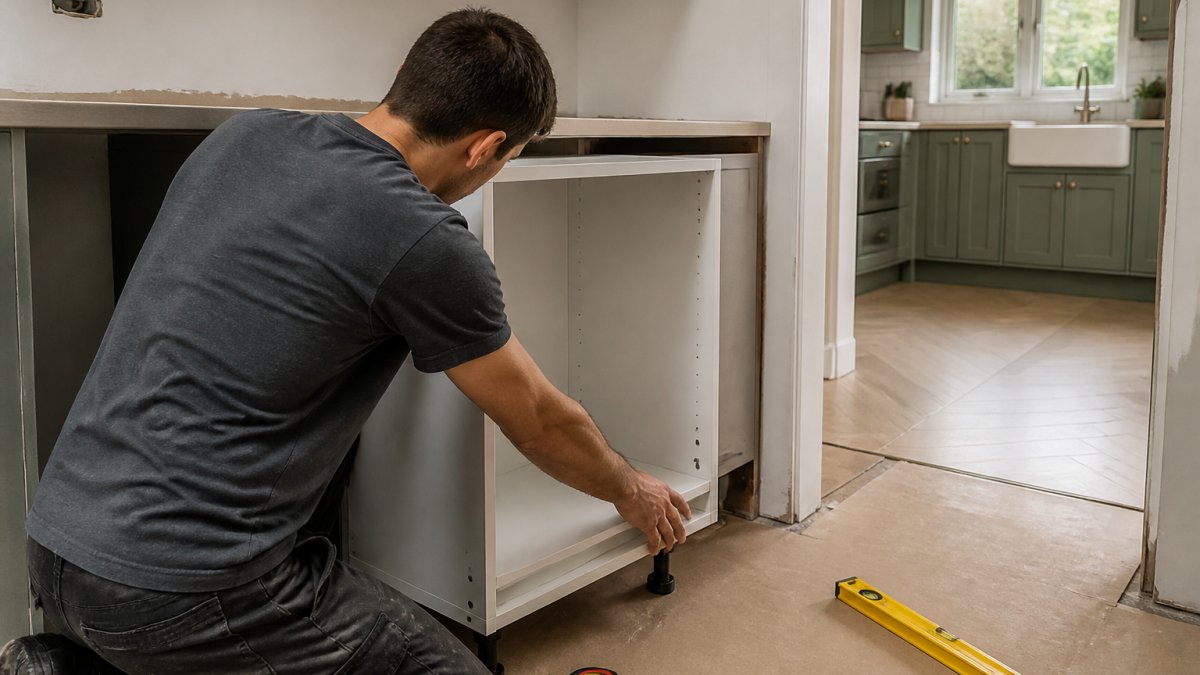
At Wjskitchenwarehouse, we supply custom carcasses to homeowners, builders, and kitchen fitters. Our custom carcasses are made to order with 14-day lead times.
The distinction affects how your kitchen looks when finished, how long the project takes, and what you'll spend.
Cost Comparison: Custom Carcasses Against Flat-Pack Options
Most comparisons stop at the cabinet price, the least useful number in the project. What matters is the installed cost per usable cabinet, once delivery, assembly, installation, fillers, panels, hardware and likely rework are counted.
The line items that decide the total
A kitchen carcass project carries the same cost categories whichever route you take. What changes is who pays for them and how predictable they are:
- Cabinet boxes: flat-pack units are priced per standard unit; custom carcasses per fabricated box, rising with non-standard dimensions and internal specification.
- Delivery: flat-pack often arrives as multiple flat boxes on a pallet, sometimes across more than one drop; custom carcasses arrive assembled on a scheduled date.
- Assembly labour: flat-pack carries a real assembly cost, your own time or a fitter's day rate. Custom carcasses arrive ready to fit.
- Installation labour: broadly similar per unit, but flat-pack is slower because units must be assembled, squared and levelled on site.
- Fillers and panels: flat-pack layouts in non-standard rooms typically need more filler and end panels to close gaps, charged per item.
- Hardware: hinges, drawer runners and soft-close mechanisms are often an upgrade line on flat-pack and included or specified on custom.
- Rework and corrections: mis-assembled or out-of-square flat-pack carcasses generate callbacks, replacement panels and extra fitter hours, a cost that rarely appears in the quote but always appears in the project.
How the gap narrows
The headline cabinet price favours flat-pack; the installed cost favours it far less. Once you add assembly time, filler panels, hardware upgrades and a rework allowance, the gap is usually much smaller than the box price suggests. Where a custom carcass fits the room first time, it can also avoid the second delivery and extra fitter day a flat-pack correction often triggers.
What drives the price up or down
Custom cost is driven by carcass dimensions, material choice (plywood and solid wood sit above engineered board), internal fit-out such as drawers and pull-outs, and the number of non-standard units. Flat-pack cost is driven by unit count, hardware tier, and how many fillers and panels the room forces you to buy.
Pricing depends on your specific requirements, delivery location and material choices. For current pricing and an itemised quote tailored to your project, contact Wjskitchenwarehouse directly to understand the total cost of ownership for your renovation.
Understanding Flat-Pack Kitchen Cabinets and Assembly Requirements
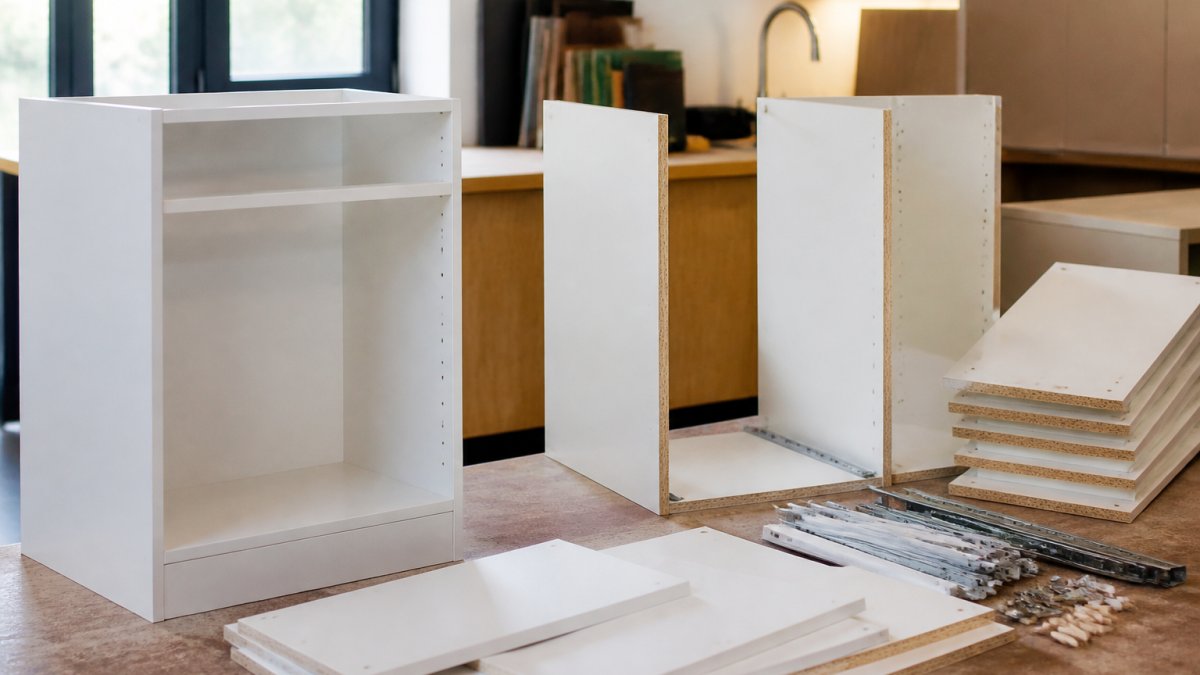
Flat-pack kitchen cabinets arrive in boxes with pre-cut components, hardware, and assembly instructions. You receive cabinet sides, shelves, backing panels, and doors separately, then assemble them using provided screws, dowels, and cam locks.
The appeal is straightforward: lower initial cost and the ability to start work immediately after delivery, with no fabrication wait.
However, assembly quality depends heavily on execution. Common issues include:
- Doors that don't align properly if the carcass isn't square
- Shelves that sag under weight if internal bracing is inadequate
- Difficulty achieving a level, professional finish without experience
- Limited ability to adapt to non-standard spaces
Flat-pack assembly requires basic tools (drill, screwdriver, level, measuring tape) and patience.
For trade customers and builders, flat-pack assembly is often outsourced to installers, which adds labour costs back into the equation.
Custom-Sized Kitchen Cabinets: Design Flexibility and Fit
Custom-sized kitchen cabinets solve the problem flat-pack units create: they fit your actual space, not an approximation of it.
This flexibility extends to design. You're not constrained by standard compartment sizes. Learn more about how our design service creates bespoke solutions that match your exact needs.
The design process typically involves room measurements, CAD drawings, and approval before fabrication begins.
Custom carcasses also let you choose materials and construction methods to suit your budget. You control that choice rather than accepting the flat-pack manufacturer's.
The lead time for custom carcasses is typically 14 days from order confirmation, depending on material availability and current order volume.
Flat-Pack Kitchen Assembly: Time, Effort, and Installation Timelines
Flat-pack kitchens move faster from purchase to installation: once delivered, you can begin assembly immediately, with no design process or fabrication wait.
However, the timeline can be deceptive. Assembly itself takes time, and mistakes add days.
Professional installation of flat-pack units typically takes 1-2 days for a standard kitchen, depending on the number of units and complexity. DIY assembly takes considerably longer, especially if you're learning as you go. For detailed guidance on installation requirements and timelines, review our professional installation guide.
The real timeline advantage of flat-pack appears with a professional installer who assembles these units regularly. If you're planning DIY assembly, the time savings largely disappear.
Custom carcasses, by contrast, arrive pre-assembled and ready for doors and worktops. Installation is faster because there's no assembly step, you're fitting pre-built units, not fabricating on-site.
Kitchen Carcass Materials: Construction Quality and Durability
The carcass is the structural foundation of your kitchen. Its material and how it is put together determine how long the cabinets last and how well they handle daily use, where custom and flat-pack solutions diverge most.
Carcass material and thickness
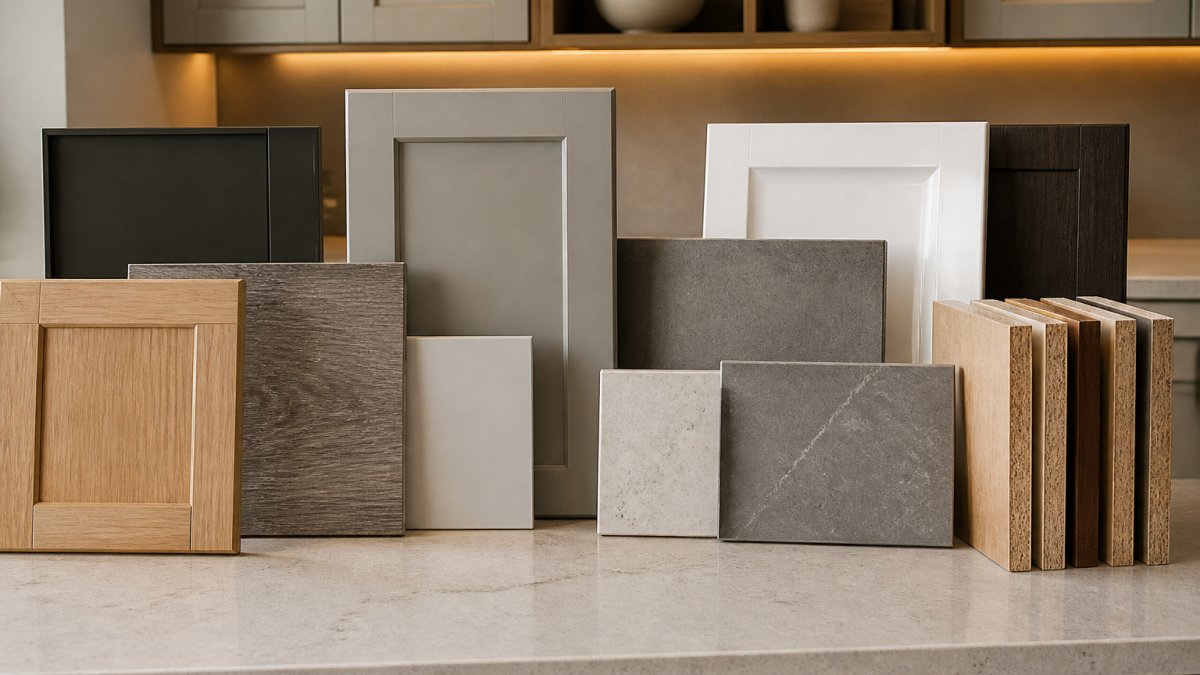
Flat-pack cabinets typically use particleboard or MDF with a veneer or laminate finish, cheaper to produce but more vulnerable to moisture, weight stress and impact: particleboard swells when wet, and MDF can sag under heavy loads.
Carcass thickness matters as much as the material. An 18 mm board is the common baseline for a rigid box; thinner boards flex more and transfer that movement to doors and drawers. Ask what thickness the sides, base and shelves are, not just the material name.
Edging, joints and back panels
These three details separate a carcass that stays square from one that does not:
- Edging: ABS or matching laminate edging on every exposed edge seals the board against moisture ingress. Untaped or thinly edged shelves are the first place swelling appears.
- Joints: cam-and-dowel construction is standard in flat-pack; glued and screwed or dowelled joints are more typical of custom carcasses and resist racking better over time.
- Back panels: a full 18 mm back panel stiffens the box far more than a thin hardboard back, which is why custom carcasses tend to hold their square through installation and use.
Hardware compatibility
Carcass construction dictates which hardware you can fit later. Standard 32 mm system holes allow adjustable shelves and a wide range of hinges and runners. Custom carcasses can be drilled to suit specific hardware, Blum and Hettich components, for example, so drawer runners and soft-close hinges align without adapters or re-drilling. Flat-pack units are usually pre-drilled to a fixed pattern, which limits later upgrades.
For a detailed comparison of materials and their durability characteristics, review our guide to cabinet material selection.
Durability, warranty and repairability
Flat-pack units, once assembled, are largely non-serviceable: if a shelf breaks or a component fails, you are often replacing the entire unit. Over a 20-year kitchen lifespan, a durable custom carcass often delivers better value than a flat-pack alternative that needs replacement or significant repair after 10-12 years.
| Aspect | Custom Carcasses | Flat-Pack Cabinets |
|---|---|---|
| Material | Plywood, solid wood | Particleboard, MDF |
| Typical board thickness | 18 mm | 15-18 mm |
| Edging | ABS or laminate on exposed edges | Often thin or untaped |
| Joints | Glued and screwed or dowelled | Cam and dowel |
| Back panel | Full 18 mm | Thin hardboard |
| Hardware compatibility | Drilled to suit specified hardware | Fixed pre-drilled pattern |
| Durability | 20+ years typical | 10-15 years typical |
| Moisture resistance | High | Low to moderate |
| Repairability | Yes, parts available | Limited or none |
| Weight capacity | High | Moderate |
| Cost per unit | Higher | Lower |
Choosing Between Custom and Flat-Pack: A Practical Decision Guide
The choice depends on your specific constraints: budget, timeline, space, and long-term expectations. Neither option is universally "better", they solve different problems.
Choose custom kitchen carcasses if:
- Your kitchen has non-standard dimensions, alcoves, or sloped ceilings
- You want maximum storage and design flexibility
- You're planning to stay in the property long-term (10+ years)
- You prioritise durability and the ability to repair or modify later
- You're working with a professional designer or installer who can optimise the layout
Choose flat-pack if:
- Your kitchen is a simple rectangular layout with standard wall heights
- You need the project completed quickly with minimal lead time
- Your budget is constrained and you're comfortable with assembly work
- You're renting or planning a shorter-term kitchen solution
- You have the skills or access to professional assembly help
Three questions decide it. First: does your space require custom dimensions? Second: what's your timeline? Third: what's your total budget including assembly labour?
Many homeowners find that a hybrid approach works best. Custom carcasses for the main run of units, with flat-pack components for simpler areas or future expansion.
At Wjskitchenwarehouse, our design service helps you navigate this choice: how a custom carcass solution would fit your space, what materials suit your budget, and the total timeline and cost. Explore our design service to see how custom carcasses could work for your kitchen.
The real decision isn't custom versus flat-pack in the abstract, it's which approach solves your specific problem.
Frequently Asked Questions
What is the main difference between custom kitchen carcasses and flat-pack cabinets?
Custom kitchen carcasses are built to your exact measurements and specifications, arriving pre-assembled or ready for professional fitting. Flat-pack cabinets come in standard sizes with components you assemble yourself or hire someone to install. Custom carcasses offer precise fit for any room layout, while flat-pack options provide affordability and flexibility for standard spaces. Your choice depends on your budget, timeline, and whether your kitchen has unusual dimensions or layout challenges.
Are custom kitchen carcasses more expensive than flat-pack options?
Custom kitchen carcasses typically cost more upfront because they're made to order and tailored to your space. However, the total cost depends on materials, complexity, and labour. Flat-pack cabinets have lower material costs but may require professional assembly, which adds expense. For awkward layouts or premium finishes, custom carcasses often provide better value despite higher initial pricing. Request a detailed quote to compare total project costs, including installation and any modifications needed for flat-pack units to fit properly.
How long does flat-pack kitchen assembly and installation take?
Flat-pack kitchen assembly typically takes 2-5 days for a standard kitchen, depending on cabinet count and complexity. DIY assembly takes longer and requires basic tools and patience. Professional installation is faster and ensures proper alignment and stability. Custom kitchen carcasses with professional fitting usually take 1-3 days once delivered, since components arrive pre-assembled or partially assembled. Lead times differ: flat-pack stock items ship quickly, while custom carcasses usually have 14-day lead times before installation begins.
Which option works better for an awkwardly shaped kitchen or room with unusual dimensions?
Custom-sized kitchen cabinets are the better choice for awkward layouts because they're fabricated to fit your exact space, including sloping ceilings, alcoves, or irregular walls. Flat-pack cabinets come in fixed standard dimensions, so fitting them into non-standard spaces often requires modifications, filler panels, or gaps that waste space and look unfinished. If your room has measurements that don't align with standard cabinet widths (typically 300mm, 400mm, 500mm, 600mm increments), custom carcasses eliminate guesswork and ensure a professional finish without compromises.